
Use Critter Fence Wire to Protect Your Plants From Gophers!
The Agony of Losing your hard work to Gophers
Prevention
is the Name of the Game
We trialed a CritterFence product because of its longevity and ease of shaping the material. Its 1/2” grid openings were small enough to prevent gophers, moles, and voles from entering the protected beds.
Jim also created open-ended tubes with the critter-fence to plant trees and shrubs.
Protected the roots without impeding taproot development. He found 3 ft depth was enough to protect.
The Agony of Losing your hard work to Gophers
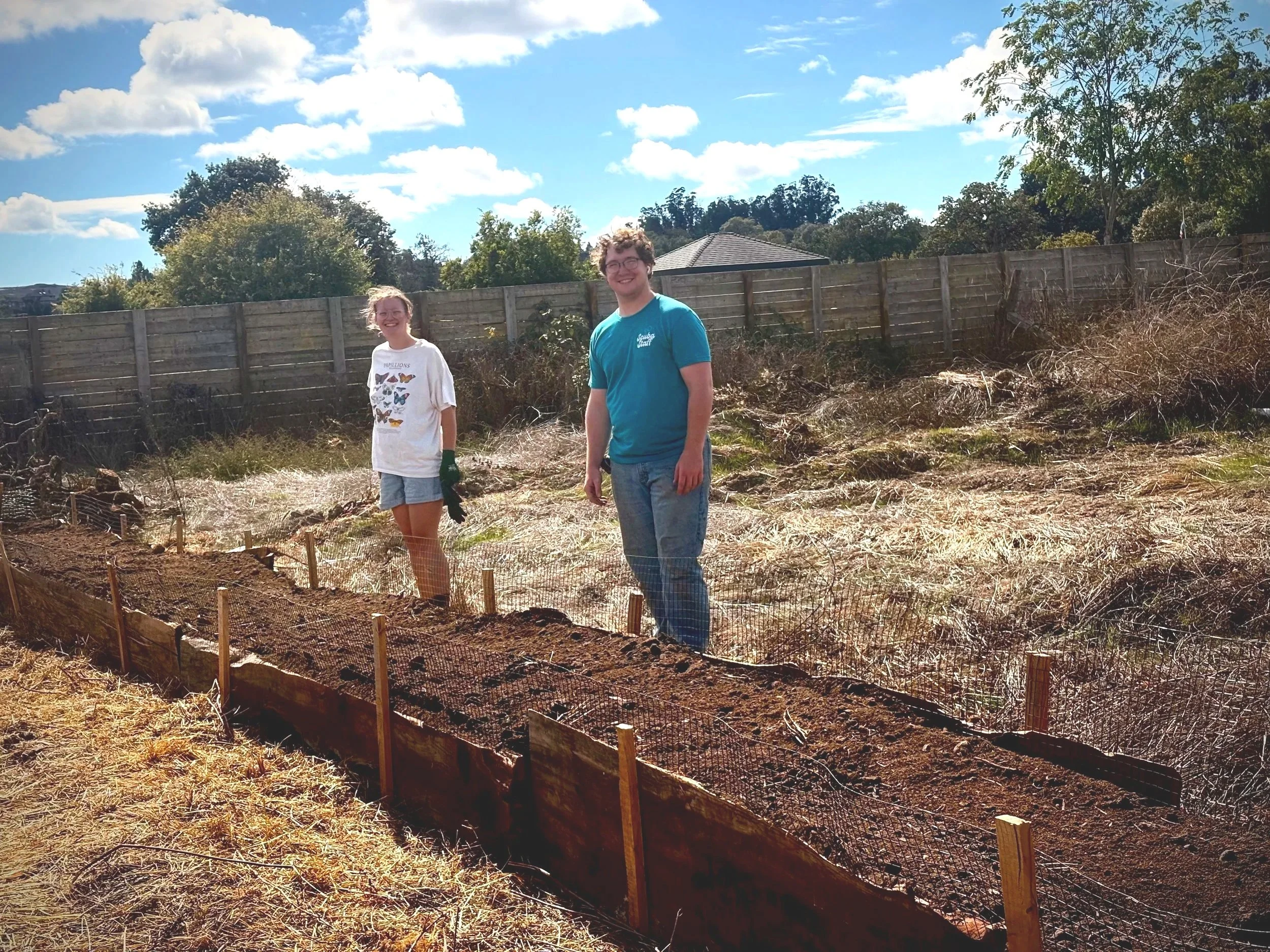
1) Shape wire into a basket, support sides & ends
2) Fill with amended Soil/Compost
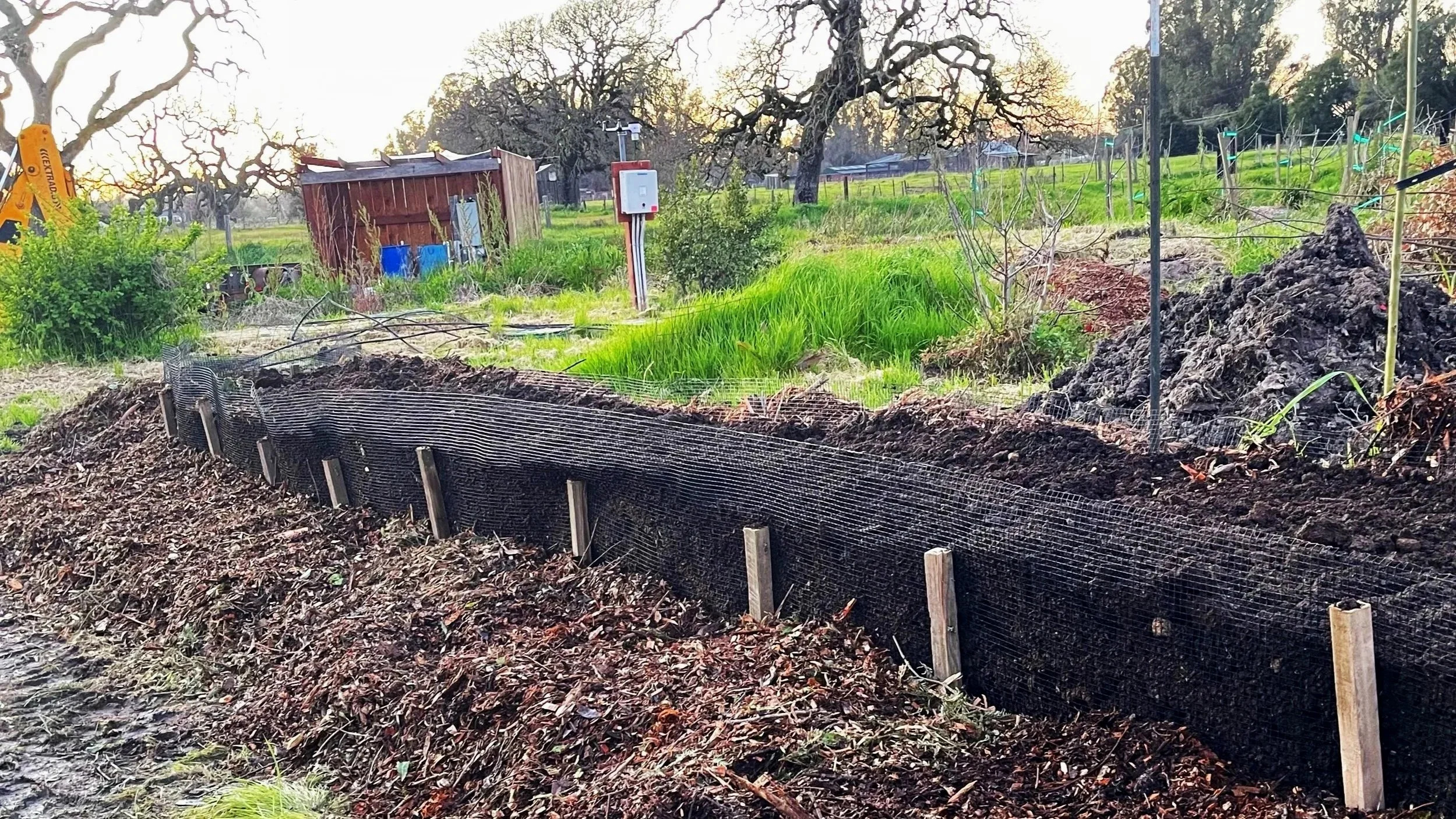
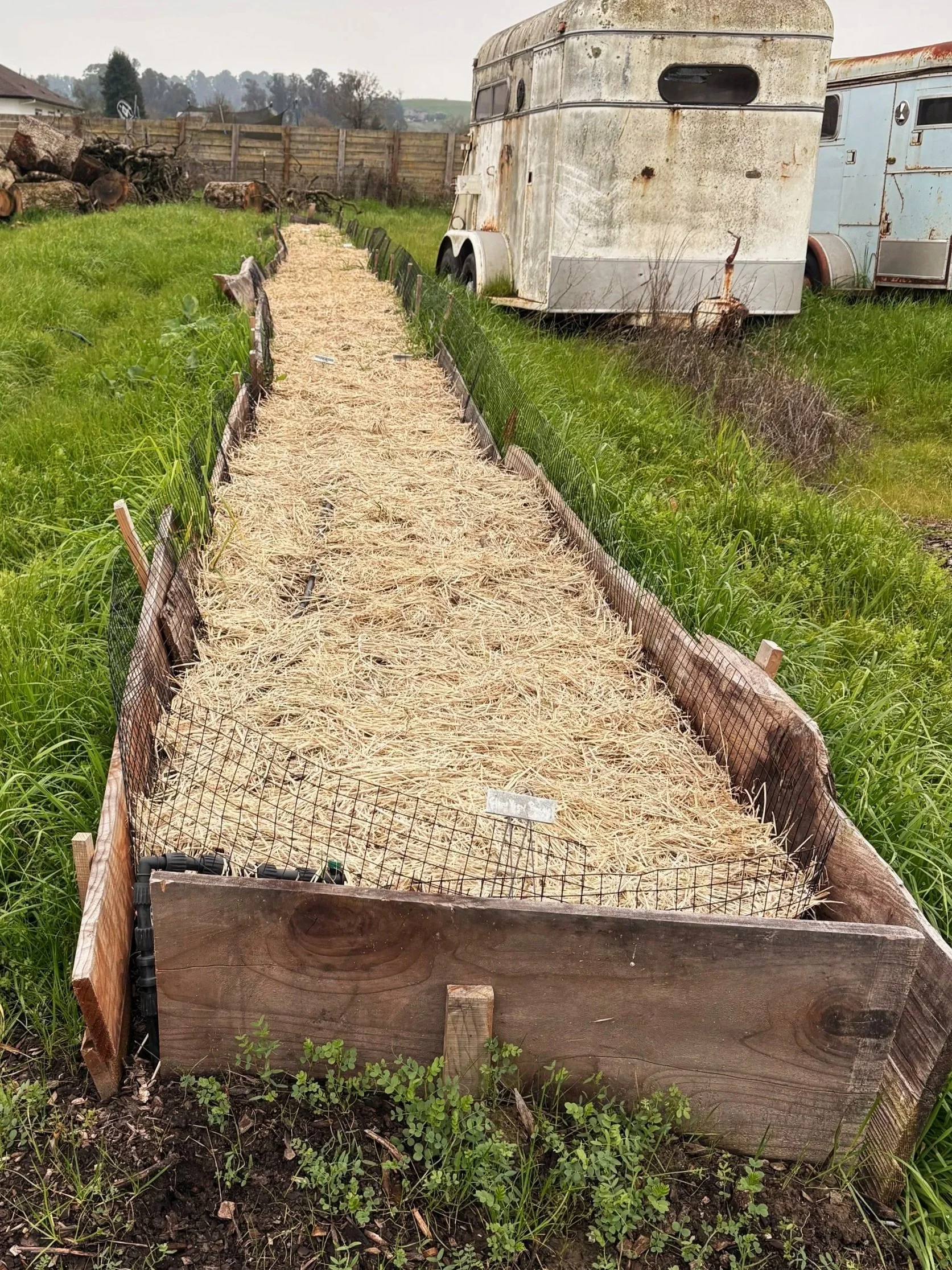
3) Add irrigation lines, PLANT, and mulch bed with rice straw.
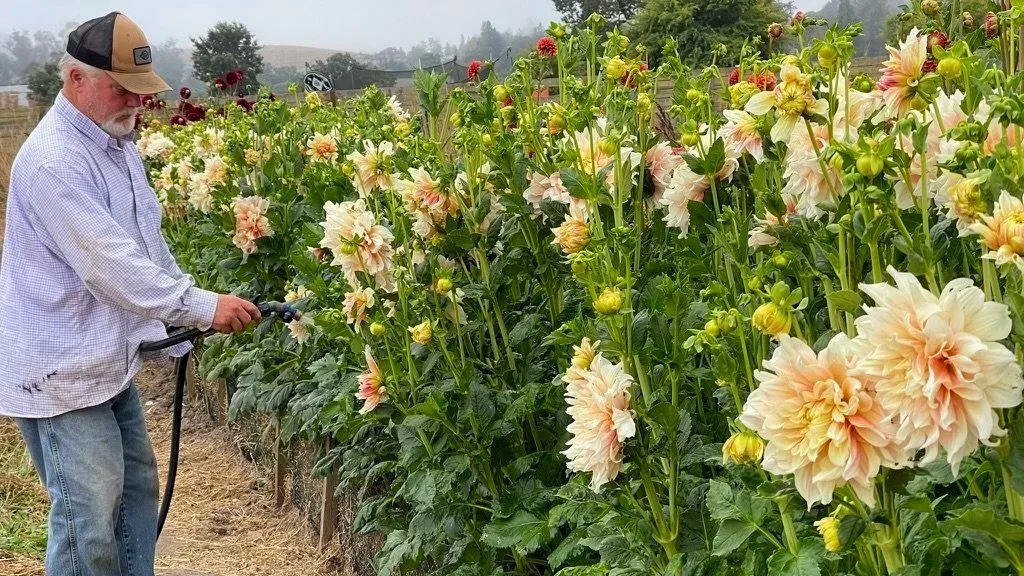
Another advantage of the raised bed with wire sides is that the soil warms up earlier and has excellent air-to-soil exposure. Better air exposure to the roots enhances plant growth. Jim is spraying our homemade “live compost tea”, the only fertilizer we use on the farm. (Soil drench & foliar spray)

4) Reap your rewards from protecting the root system!
Critter Fence ProtectionThe Agony of Losing your hard work to Gophers
It is not something I would wish on anyone, and yet in our area of California, it is a constant battle for most.
We quickly realized, after losing 85% of my first dahlia production bed, that dahlia tubers (and potato tubers) are like candy to the little suckers! The search was on!
First, we tried chicken wire; it lasts maybe 3 years, but by the 4th year, contact with the soil had disintegrated the wire. Hardware cloth lasts longer, but it is hard to work with and very expensive for how long it lasts. We were looking for a long-term solution; we wanted more than 5-6 years (too much work to replace, too).
A friend mentioned CritterFence.com. Very pricey; no one local sells it, BUT it has a 25-30-year lifespan. We decided to give it a try.
We played with several variations by First creating a basket out of the wire using 6 ‘ wide wire x 50’ long (basically a wire bed to protect the root systems). It was fairly easy to shape.
We tried a bed in the ground with a 4” raised border, an 18” high raised bed, and tubes in the ground (for trees and shrubs) with a raised border. The only caveat is that you must make sure the edge of the wire is at least 4-6” above the soil level so that desperate gophers do not climb over.
Every variation worked perfectly! So while the wire might sound expensive, the longevity and protection it provides for expensive plants, shrubs, and trees were well worth it. We have now put in over 15 beds, and more will go in this year.
Order
You can order online from CritterFence.com, and they will ship it within several weeks. We liked it so much that, to help reduce shipping costs, we ordered a pallet (16 rolls). We will probably use 8 rolls this year, and the other 8 are up for grabs for a small, small fee (HA!)
$400/for a 1/2” grid, 6 ft wide by 100 ft long. The 1/2” grid is tight enough to prevent gophers from getting into the bed. 1” openings are just too large and allow the smaller gophers to get through. $5/linear foot (6ft wide), but we will only have one roll, so we will break it down into smaller lengths.
(If you want a 3ft diameter tree/shrub protection tube, you would need 10 ft of critter fencing wire. 10’ x $5 = $50) You could cut your tube in half (6 ft/2 = 3 ft height) and end up with $25 per tube of protection.
Constrution
Because Jim creates his own compost soil, we now opt for a raised bed that is slightly embedded in the ground about 6 inches, rising 18” above the ground & 24-30” wide, filled with our own compost/soil.
He supports the sides about every 3 ft with stakes pounded into the ground (we have used rebar, but it has its own issues). I used old tennis balls to protect myself from getting hurt by the metal tops of rebar stakes. - I like the stakes better.
Whether used for flowers or veggies, the beds are awesome. Tree and shrub protection is excellent as well.
Tips
Remember, you are creating a basket, so you must account for the ends in your calculations. Your length will need end walls of the same height as your sides.
I use Rice Straw (no weeds, unlike hay) to cover the sides and mulch the top for weed protection. We use wood chips on the paths (they break down in a year, creating wonderful humus that I top off the beds with, the next year).
DO NOT mulch the top of the beds with woodchips! It ties up the nitrogen in the soil.
2-3 drip lines create irrigation for the raised beds.
Go to CritterFence.com to get more detailed information about the gopher wire.

Amy showing her gopher protected dahlia planting beds.
“Live“ Compost Tea
Moving away from artificial fertilizers was a huge game-changer on our farm. It solved nutrition and pest problems by letting nature take charge. Instead of trying to “feed” the plants, in the typical Western approach to growing plants, our model changed. We feed the microbes in the soil.
Here is the Basic Concept: What if Pests and diseases are nature's way of getting rid of sick plants? So the question becomes: “How can we increase the health of our plants?”
Research now shows that a highly sophisticated system is already in place to feed plants, and our chemical approach interferes with it. Over the last billion years, nature has developed a system we need to tune into.
Microbial life in the soil, mycorrhizae, fungal, and bacterial systems have a symbiotic relationship with plants. In short, soil life feeds the plants what they have asked for, and in return, the plants feed the microbes carbohydrates they have photosynthesized. Better yet, the microbes feed plants the nutrients they ask for in a FORM the plants can easily take up.
Our “Live Compost Tea” offers a salad bar of ingredients for the microbes to utilize. You can take one gallon of “tea” and dilute it with 4 gallons of water (non-chlorinated) and use it as a spray or soil drench. You cannot add too much, and you can apply it to container plants as well. We use it about every 2-3 weeks during the growing season, starting in February in our area of California, to jump-start the season.
We have been doing a “proof of concept” with our live compost tea. Anybody can tell you anything on the internet, but the proof is in the pudding! Over the last 5 years, we have seen phenomenal health in our plants and a corresponding decrease in pest or disease pressure. You are welcome to come visit the farm and see the results.
We sell the tea onsite; bring your own bucket (with lid). 1 gallon/$5. 5 gallon/$35 (one gallon of tea to 4 gallons of water)
You can dilute 1:4 (5-gallon bucket) for all plants, up to 1:10 (for seedlings).
Once you are introduced to the process, you can come almost anytime and serve yourself
(There is a money jar for cash and Venmo for cashless purchases)
Honor System
WHY and WHAT
We go back to nature for a broad array of potential nutrients. There are micronutrients in natural ingredients that we may not even realize they need. Into the tea we add alfalfa pellets, worm casings, fish fertilizer, kelp meal, molasses, soluble calcium, and wet/fresh cow manure. Additionally, DE (diatomaceous earth), Baccillus, and mycorrhiza.
This is all added to a barrel of aerated water for a minimum of 3 days before use. Aeration keeps microbial life alive, while molasses feeds the microbes as they reproduce. When added to the soil, you are inoculating soil microbes as well as a salad bar of nutrients for the microorganisms to draw from to feed the plants.
Why wet/fresh cow manure? Because the gut system of cows have the microbes needed to innoculate the soil. Like the buffalo they are forage creatures. You can use the other ingredients without the manure but the cow manure microbes enhances the soil itself. (Horse manure does NOT have the microbes desired).
No petrochemical artificial components. By feeding artificial fertilizers, we break up that symbiotic relationship, starving the microbial life in the soil when the plant does not deliver the carbohydrates it photosynthesized. They essentially kill the life in the soil. Yes, you can feed artificial fertilizers, and plants can grow big & fast… but are they healthy? I use the example of eating a hamburger, French fries, & a milkshake every day. You will get bigger faster, but will you be healthy?
Here is the Basic Concept: What if Pests and diseases are nature's way of getting rid of sick plants? The question becomes: “How can we increase the health of our plants?”